"Look!"
"Oh, that's beautiful."
And she is gone, back to the crayons. The page lands on the pile with the eleven other beautiful ones, and by Friday nobody can tell them apart, her included. If you have caught yourself using the same word for every page, this guide is the fix: how to praise your child's art so they can hear that you actually looked, with ready lines for the pages that are hardest to answer.
Why does "that's beautiful" stop working?
The word itself is fine. It just fits every page, so after a few weeks it only tells your child that you are done looking. Children are quick to hear the difference between a reply and a reflex.
There is also research on what praise does next. In Carol Dweck's well-known studies, fifth graders praised for being smart mostly picked the easy task afterwards, while those praised for their effort mostly picked the hard one. A later study by Eddie Brummelman and colleagues used drawings. Children copied a painting and were told either "you made a beautiful drawing" or "you made an incredibly beautiful drawing". Children with low self-esteem who heard "incredibly" went for the easy pictures next time. One word made the difference, and it held back exactly the children who wanted the praise most.
So the fix is a smaller reply, one that could only belong to this page.
What do you say instead?
Two sentences, in this order.
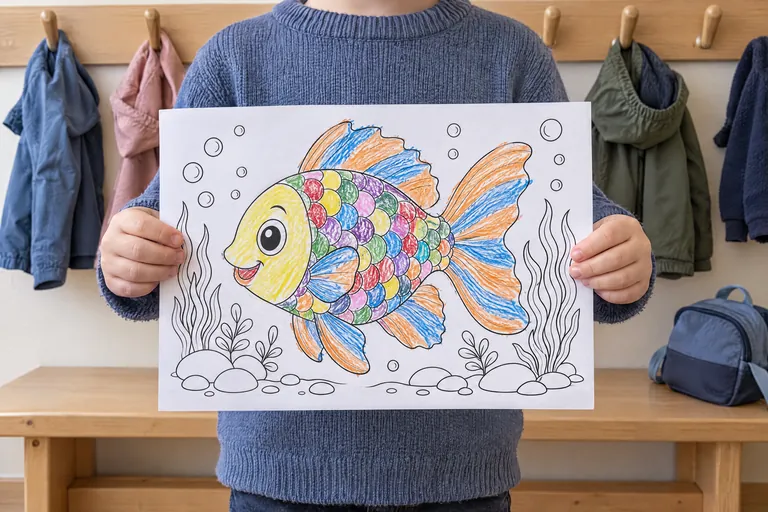
- 1Describe one thing you can see. A color, a line, a place on the page, how much of something there is. "You gave every scale on that fish its own color." The early years organisation NAEYC puts it simply: notice and comment on what you see. A describing sentence carries no verdict, so it works for a scribble as well as it does for a careful page.
- 2Ask one question about how. "Which part did you do first?" "How did you get that green so dark?" The question points at their choices and their effort, which is what the research above rewards.
Then stop. If your child wants to tell you more, they will. If they run off, the sentence has still landed.
One habit is worth dropping on the way: guessing. "Is that a horse?" about the dog they drew stings more than silence. "Tell me about it" costs nothing and lets them name it.



Coloring fun for kids — anywhere.
Free for iOS & Android. No ads, no sign-up, offline-ready.


Coloring fun for kids — anywhere.
Free coloring app for kids. iOS and Android, phones and tablets. No ads, no sign-up, even offline.
What about the pages that are hard to answer?
Some pages make the describing sentence feel awkward. These are the lines that tend to work.
| What they hand you | Say first | Then ask |
|---|---|---|
| The scribble | "You went all the way from this corner to that one." | "Was it fast or slow to make?" |
| The page in one color | "It's all blue, even the sun." | "What made you pick blue today?" |
| Colored far over the lines | "Those big strokes go right off the edge." | "Should the next page have bigger spaces?" |
| The rushed page | "You got to the end really quickly." | "Which bit would you do again?" |
| The one they want to throw away | "You're not happy with the face." | "What did you want it to look like?" |
If the one-color page shows up every day, why a child sticks to one color has the longer answer, and if the lines are the real worry, read what coloring inside the lines does to creativity.
The last row is the hardest. The quick reflex is to argue: "It's lovely, don't be silly." Your child hears that their own eyes are wrong. Agree with what is true, ask what they were going for, and print a fresh copy, which is the one thing a printable page can do that a book cannot. Put the unhappy page in a drawer for a day before it goes in the bin. Quite often it comes back out.
Is it normal that my child keeps asking "Is it good?"
Mostly, yes. Asking for your opinion, wanting the page on the fridge today and forgetting it tomorrow, being cross with a page that does not match the picture in their head: all of that is ordinary. The self-criticism usually grows once children start comparing, often from around five, and what changes at each age walks through when that happens.
Worth a closer look is a pattern that lasts for weeks: every page ends in tears or torn paper, or your child will not start at all in case it turns out wrong. The practical side of that is in when your child refuses to color. If the same fear shows up in other things too, mention it to the kindergarten or school teacher, or to your paediatrician.
What else could you color?
Pick a prompt or type your own — opens in a new tab.
Next time
Next time a page slides across the table, swap "beautiful" for the first true thing you see, then ask one question and wait. It takes about ten seconds. The page probably still ends up on the pile, but your child walks away knowing which part of it you noticed.