Every parent has bought the wrong coloring tool at least once. The thin markers that dried out because the cap never made it back on. The colored pencils that snapped under a determined three year old. The set labeled "washable" that turned out to be more of a suggestion. Usually the product was fine. It just did not match the hand holding it.
The best coloring tool for your child is not the one with the most colors in the tin or the highest rating. It is the one that fits how much control your child has today: how they grip, how hard they press, and how long they stay interested before the fun runs out. All three of those shift a great deal between two and twelve, so the tools in the drawer should shift too.
Here is how to match the tool to the stage, and how to spot the moment your child is ready for the next one.
Start with the hand, not the tin
Before you compare brands, it helps to know what actually changes as a child grows, because that is what decides whether a tool works for them.
Three things move the most. Grip comes first. A toddler holds with a whole fist and a straight arm, and the thumb-and-two-fingers hold that a pencil really needs only arrives later. Pressure comes next. Little children bear down hard and unevenly, which snaps pencil leads and tears thin paper, while older children gradually learn to lighten up. Stamina and aim come last. Staying roughly inside a shape, and wanting to keep going for more than a minute, is a skill that builds over years and cannot be bought in a better marker.
That order is fairly predictable. Occupational therapists describe a dynamic "tripod" grip, with the pencil resting between the thumb and first two fingers, as settling in for most children around ages four to six, with a wide and completely normal range. Coloring is one of the everyday activities that helps that grip along, which is a good reason not to wait for it before you start.
The tools, matched to the stage
Toddlers do best with something forgiving that makes a bold mark for very little effort, which is why chunky crayons win the early years. Preschoolers, with steadier hands, can add washable markers for the instant, satisfying color that keeps them coming back. School-age children have the control for colored pencils and the patience they reward. Tweens can use whatever an adult would, and often want the finer tools precisely because they take more skill.
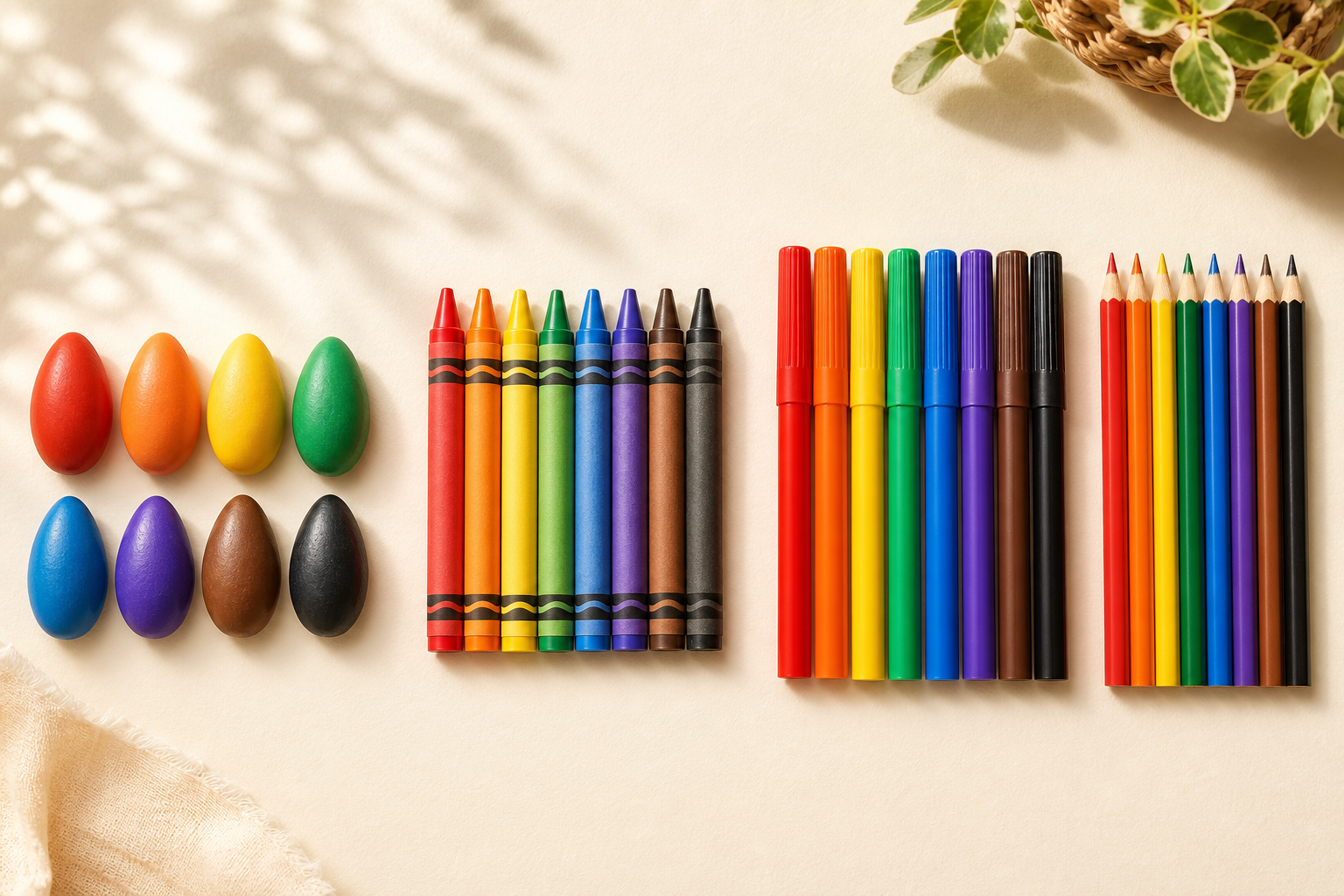
The table below is a starting point, not a rule. Children arrive at each stage on their own schedule.
| Age stage | Reach for first | Why it fits | Add when ready |
|---|---|---|---|
| Toddler (about 2 to 4) | Chunky or egg-shaped crayons | A whole-fist grip and heavy hand suit a short, unbreakable tool that colors with almost no pressure | A few washable markers, closely watched |
| Preschool (about 3 to 5) | Washable markers with standard crayons | Steadier hands enjoy instant, vivid color, and markers reward light pressure and need no sharpening | Thick, soft colored pencils |
| School-age (about 5 to 8) | Colored pencils | A settling tripod grip and more patience suit a tool built for detail and layering | Fine-tip markers, a small sharpener |
| Tween (about 9 to 12) | Whatever an adult would use | Full control and real interest in technique, so finer tools feel like an upgrade rather than a struggle | Blendable pencils, gel pens, a wider palette |
If you want the reasoning behind each tool rather than each age, our companion guide on choosing between crayons, markers, and colored pencils walks through them one at a time.



Coloring fun for kids — anywhere.
Free for iOS & Android. No ads, no sign-up, offline-ready.


Coloring fun for kids — anywhere.
Free coloring app for kids. iOS and Android, phones and tablets. No ads, no sign-up, even offline.
A few things that matter more than the brand
Once the tool roughly fits the age, the details that make or break an afternoon have little to do with which company made it.
Safety comes first, always. Look for a non-toxic mark on anything a young child might chew, and keep thin barrels and small caps away from toddlers who still put things in their mouths. Washable beats vivid early on. For the trade-off between the two kinds of markers, and when to switch, see washable versus regular markers. The paper matters more than parents expect. Markers bleed through thin printer paper and pencils skid on it, and a slightly heavier sheet fixes both, which we cover in choosing paper for coloring at home.
If you are choosing tools for one particular child and want the whole developmental picture, our overview of what to expect from coloring at each age puts the stages side by side.
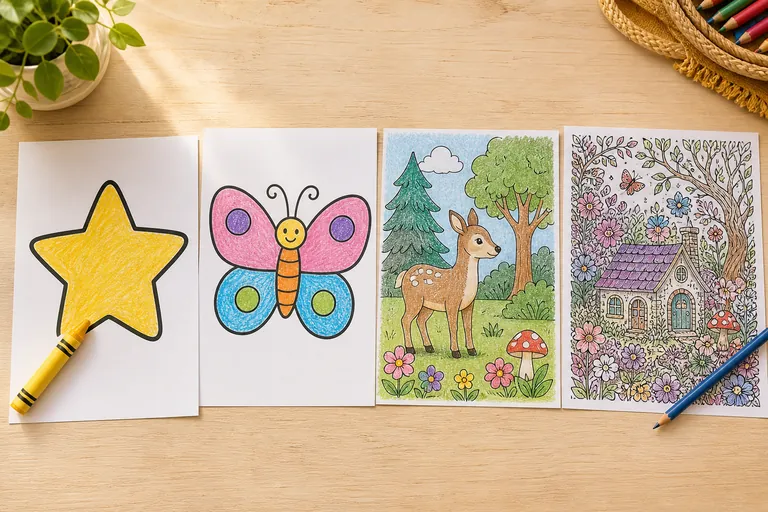
Once you have the tools sorted, the next question is what to color. Simple, bold shapes suit the youngest hands, and busier scenes reward the steadier ones.
What else could you color?
Pick a prompt or type your own — opens in a new tab.
Let them outgrow it on their own
The clearest sign a child is ready for the next tool is not a birthday. It is what they do with the one they already have: a toddler who starts turning the crayon for a finer line, a preschooler asking why the marker will not make thin edges, a school-age child frustrated that crayon cannot capture the detail they can now see. That is the moment to add the next tool alongside the old one, never to replace it.
Keep the outgrown tools in the drawer. A tween who spends an afternoon with fat crayons is not going backward, they are relaxing, the same way an adult doodles in a meeting. The goal was never to climb the ladder as fast as possible. It was to keep a child reaching for color on their own, with a tool that feels good in the hand, for as many years as it holds their interest.