The paper nobody thinks about until the marker bleeds through
You find the page, hit print, hand over the markers, and ten minutes later there is a butterfly-shaped stain on the kitchen table. Paper is the one coloring supply most of us never choose on purpose. It is just whatever happens to be loaded in the printer, and for a lot of coloring that is completely fine. But the sheet under the crayon decides whether the color stays put, whether the page survives an eraser, and whether tomorrow's marker soaks straight through. Here is how to pick paper for coloring pages at home without overthinking it or overspending.
The papers at a glance
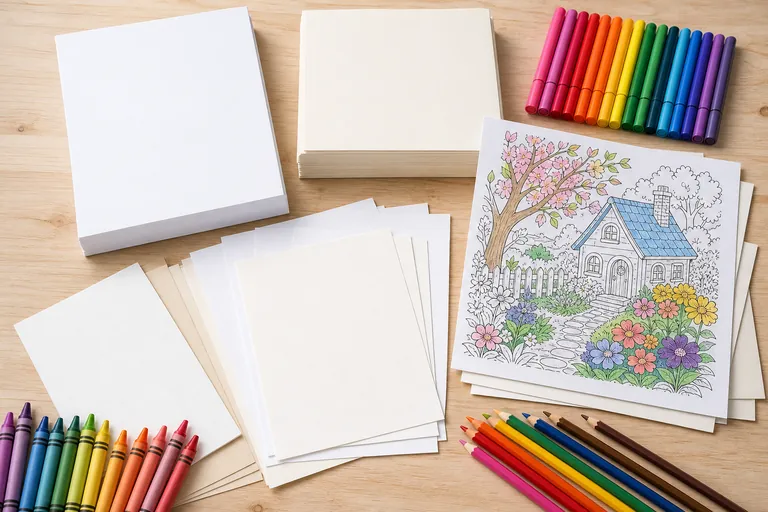
Four kinds of paper cover almost everything a family prints. Here they are side by side, from the cheapest to the sturdiest.
| Paper | Weight | Best for | Watch out for |
|---|---|---|---|
| Copy / printer paper | About 20 lb (75 gsm) | Crayons, colored pencils, quick everyday pages | Markers can bleed through; tears if erased hard |
| Premium printer paper | 32 lb (120 gsm) | An all-rounder that handles light marker work | Costs a little more than a basic ream |
| Cardstock | 65 to 110 lb (175 to 300 gsm) | Pages worth keeping, framing, or giving away | Very heavy sheets can jam a home printer |
| Mixed-media paper | Around 160 gsm | Kids who press hard, layer, or love markers | Not always sold in printer-ready reams |
If you only remember one row, make it the second. At 32 lb (120 gsm), premium printer paper is the closest thing to a do-everything sheet, and it still runs through a normal home printer.
What actually matters: weight, tooth, and bleed-through
Three things separate a good coloring sheet from a frustrating one, and none of them is the brand on the wrapper.
Weight is the big one. Heavier paper resists bleed-through, stands up to layering, and feels sturdier in small hands. It is measured in pounds (lb) in the US and grams per square meter (gsm) most everywhere else, and higher numbers mean thicker paper. According to coloring-book designer Sarah Renae Clark, water-based markers behave on paper around 120 gsm for light work, while heavier marker use is happier on mixed-media paper near 160 gsm.
Tooth is the slight texture of the surface. A little tooth gives crayons and colored pencils something to grab, so color goes down richer and blends more smoothly. Very smooth, glossy paper can feel slippery and lift pencil poorly.
Bleed-through is the one parents actually notice. It is mostly a marker problem, and it comes down to how much ink the paper can hold before the moisture reaches the far side. Crayons and pencils lay down almost no moisture, so they rarely bleed on anything.



Coloring fun for kids — anywhere.
Free for iOS & Android. No ads, no sign-up, offline-ready.


Coloring fun for kids — anywhere.
Free coloring app for kids. iOS and Android, phones and tablets. No ads, no sign-up, even offline.
Which paper for which tool
The right paper is really a question of what your child is coloring with. Match the sheet to the tool and most of the trouble disappears.
For crayons and colored pencils, plain copy paper works. If you want pages that survive being colored, erased, and colored again, step up to 32 lb (120 gsm). Pencil fans who like to layer and blend, the kind of thing covered in our guide to shading with colored pencils, get the most out of a sheet with a bit of tooth.
For water-based markers, the classic Crayola kind, 32 lb (120 gsm) handles light coloring. If your child presses hard or goes over the same spot again and again, mixed-media paper around 160 gsm holds the moisture without bleeding. This is also where the washable-versus-regular marker question comes in, because heavier washable ink asks a little more of the page.
For alcohol markers, the pricier pens older kids and tweens sometimes graduate to, you need thick paper, 90 lb (160 gsm) or more, or the ink races straight through. Heavy cardstock is close to bleed-proof here. If you are still sorting out which pens belong in the box at all, the crayons, markers, and colored pencils comparison is a good place to start.
Before you hit print
Two small habits save most of the mess.
First, check what your printer can take. Very thick stock, generally above 200 gsm, can jam a home printer or simply refuse to feed. Most printers list a maximum paper weight in the manual or the tray settings, and it is worth a ten-second look before you load a heavy ream.
Second, print a single test page. One sheet of the paper you are considering, colored the way your child actually colors, tells you more than any number on the packaging.
Ready to print
Paper is the quiet part of coloring, and now it is sorted: copy paper for crayons and pencils, a heavier sheet once markers show up, and cardstock for the pages worth keeping. Pick your paper, then pick something worth printing on it.
What else could you color?
Pick a prompt or type your own — opens in a new tab.