Pyjamas are on, teeth are done, and the story is still ten minutes away. Your four year old is doing laps of the hallway with one sock in her hand.
That gap is the hardest part of the evening. It is too late for a proper game and too early for the book, and whatever fills it decides how the next half hour goes. A coloring page fits the gap better than most things, but only if you set it up so that it ends.
What a page is doing at this hour
Nothing magic. It gives busy hands one small repetitive job, it keeps a child in one place, and it is not a screen. The American Academy of Pediatrics puts weight on those last two: it asks families to keep devices out of the bedroom and to power them down 30 to 60 minutes before lights out, and it treats going to bed at the same time every night as the part that does the real work. Something has to fill that half hour, and Pathways.org names coloring and drawing first among the quiet activities that help a child wind down.
With a three to five year old there is a second thing going on. A page at this hour is a conversation nobody has to start: what color is the cat, where does the moon go in the morning, who lives in that little house on the hill. That is the same quiet practice a preschooler gets out of any coloring page, happening at the one time of day when you are both finally sitting still.

The setup, in four small things
The setup is more of the work than the page is, and it is worth being boringly consistent about it. Four things, the same every night.
- 1One place. The same corner of the kitchen table or the same lap desk, so that nobody negotiates location at seven o'clock.
- 2One page, not a stack. A stack is an open invitation to start another one.
- 3Four or five crayons, not the whole tin. Fewer choices, less sorting, no hunt for the missing lid.
- 4An ending everyone heard. Say it before the first crayon comes out: we color until the timer goes, then the book.
Sit down too, if you can. A parent standing in the doorway holding a phone tells a preschooler that this is a waiting room, and they read that signal instantly. Ten minutes at the table beside them is usually the difference between a page that settles the evening and a page that gets abandoned after the first shape.



Coloring fun for kids — anywhere.
Free for iOS & Android. No ads, no sign-up, offline-ready.


Coloring fun for kids — anywhere.
Free coloring app for kids. iOS and Android, phones and tablets. No ads, no sign-up, even offline.
Which pages work at this hour
Not every page calms. The ones that do share a shape: big areas, few of them, and a subject that is already still. A sleeping animal, a moon over quiet hills, a pattern that repeats. Detailed scenes with thirty small fields are wonderful on a Saturday morning and a trap at seven in the evening, because a four year old can see that this will not be finished tonight, and then either rushes it or gives up on it.

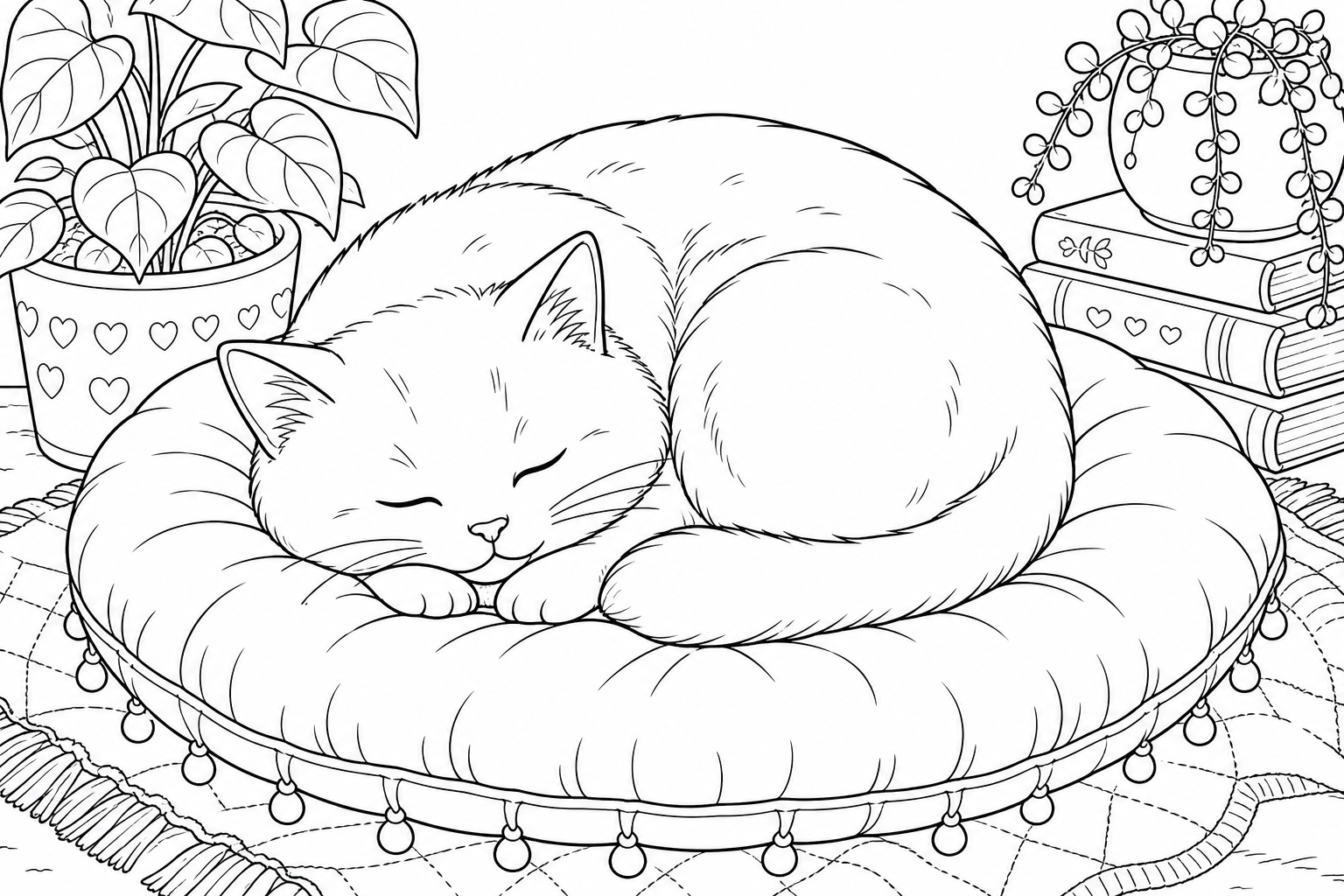

Pick the page yourself before you call your child over. Handing a three year old the whole folder puts a decision in front of them at exactly the hour they have run out of decisions.
Repeating patterns are the reliable ones. They hold attention without asking for a single choice, which is why mandala pages are worth slowing down for even with small children.
What else could you color?
Pick a prompt or type your own — opens in a new tab.
When it stops working, change one thing
Two things go wrong at this hour, and both have a small fix.
The page turns into a project. Your child wants it finished properly, tonight, and the timer becomes a fight. Then the page was simply too big. Go smaller tomorrow, and park the unfinished one somewhere visible so that it is obviously still there in the morning.
Coloring becomes the delay tactic. One more page, one more color, and bedtime has quietly moved by twenty minutes. That is a sign the step is in the wrong slot rather than a sign it does not work. Move it to before the bath, where the evening still has room for it to run long.
If the hard part of your evenings is not the wind down but the storms that arrive before it, that is a different setup altogether: a calm down corner asks almost nothing of your child and is built for the moment when nothing can be talked through.
Change one thing tomorrow and watch what it does. Put the page and the four crayons on the table before the bath, so that the spot is already waiting when the pyjamas go on. A routine mostly becomes a routine because the thing is already there.