Your child is on the floor, furious about a sock. You built the corner. Cushions, a soft lamp, a basket of good things. They will not go near it. Later, once everyone has come back down, you find yourself wondering what you got wrong.
Usually it is not the cushions. It is what the corner asks of a child at the exact moment they have the least to give.
What you are actually building
The point of the corner is not to end the feeling faster. It is to give a child somewhere to be while the feeling passes, with something to do that does not require them to talk, decide, or perform.
Hospitals and early childhood programmes describe the same small idea: a predictable space a child can retreat to and come back from on their own terms. Brown University Health frames it that way, and the Center for Early Childhood Mental Health Consultation adds the part most guides skip: you teach the space in advance, not in the middle of a hard moment.
That framing decides what belongs in the basket. Anything that asks a child to concentrate, choose, or succeed is working against the room.
Why coloring survives in that moment
Most quiet activities quietly demand something.
A picture book needs reading capacity, or it needs you. A puzzle can be failed, and a child who is already flooded does not need one more thing going wrong. A fidget toy is honest but shallow and tends to run out after forty seconds. Building toys pull a child back up into planning, which is the wrong direction entirely.
Coloring is unusual in how little it asks. There is no correct outcome, so there is nothing to lose at. The hands and the eyes get one small, repeatable job. It is quiet, it is already familiar, and it can be abandoned halfway through without anything being ruined. That combination is rarer than it sounds, and it is why coloring turns up on nearly every calming corner list, usually as one throwaway bullet.
Keep the claim modest. Coloring is not a treatment and it will not shorten a meltdown on command. It gives a child something to do with their hands while their body settles, which is most of what a hard moment actually needs. We looked separately at what happens when a child colors through a heavy feeling.
Where the corner goes
Placement decides use far more than decor does.
Keep it out of the bedroom. A bedroom is already carrying sleep, and you do not want big feelings filed in the same place.
Put it at the edge of a room the family genuinely uses, so going there is not an exile. The far end of the living room works. The spare room nobody enters does not.
Build it low. Floor cushions, a small rug, a basket within reach of a sitting child. Someone who is upset will sit or lie down, not perch.
Give it a back. A corner, the side of a bookshelf, the gap between the sofa and the wall. Enclosure on two sides does most of the work that money cannot.
Keep a sight line. Most young children want to be out of the middle of things, not out of sight of you.
Add a hard surface. This is the detail everyone forgets. Coloring on a cushion is annoying, and annoying is the opposite of the point.
What goes in the basket
| Item | Why it earns a place |
|---|---|
| A clipboard or lap desk | Makes coloring possible without a table, which is the whole reason the corner gets to be soft |
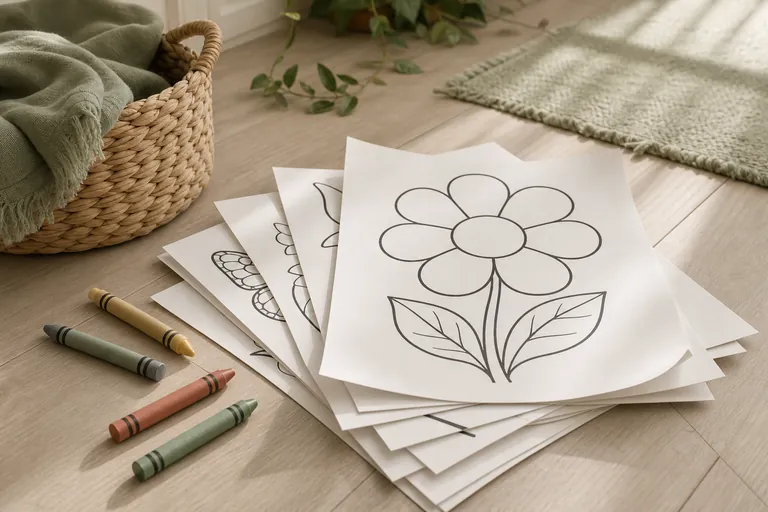
| A loose stack of pages | Ten or so, face down, so choosing takes two seconds instead of becoming a browse |
| Chunky crayons or short pencils | Forgiving in a fist grip, no lids to lose, nothing that dries out unnoticed |
| One blanket | Weight and enclosure, and it doubles as the thing they hide under first |
| A soft toy or two | Something to hold during the stretch when they are not ready to do anything yet |
| One sensory object | A sand timer, a squeeze ball, a smooth stone. One of them, not a bin |
Then leave things out on purpose. Markers that bleed through and ruin the page underneath. A bound coloring book, because a book creates a page they wrecked and a page they are behind on. Anything with small parts to lose, batteries to die, or a right answer. Screens, and also anything that beeps.
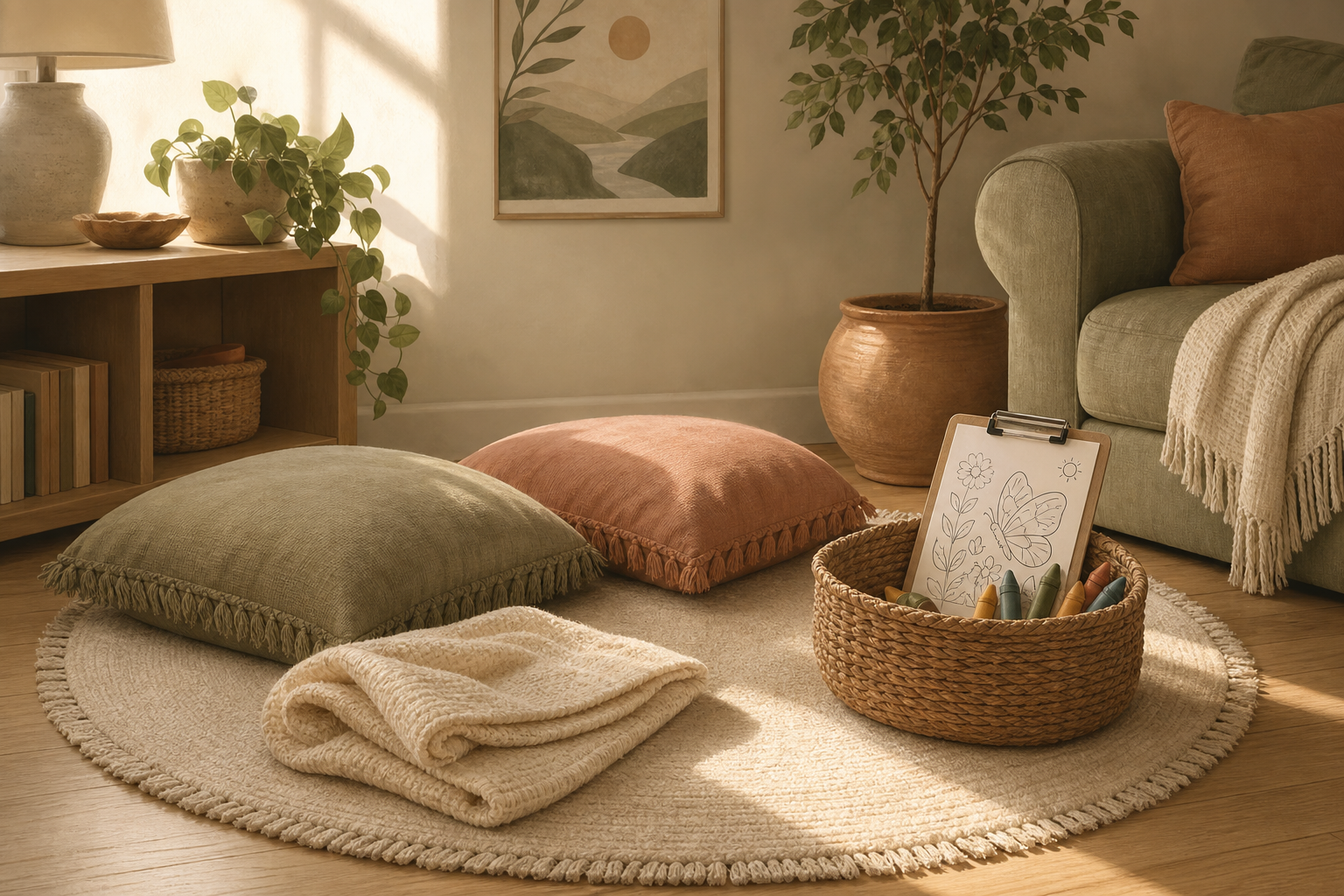
The page is the whole design
Everyone tells you to add coloring pages. Almost nobody says which, and that is the decision the corner lives or dies on.
Simple beats beautiful. The intricate page you love is a demand. Big shapes and thick outlines let a child start immediately, in a state where fine motor control has left the building.
One subject, not a scene. A single flower, one animal, one balloon. A busy scene asks a child to decide where to begin, and deciding is exactly what they cannot do right now.
Repetition earns its place with older kids. From around eight, a repeating pattern is genuinely settling to fill in, because the next move is always obvious. This is the one context where mandalas and repeating patterns deserve their reputation.
A stack, not a book. Loose pages mean the next one is free. No history, no half-finished page staring back, no collection they feel they are ruining.
Treat them as disposable. Print more than you need. A page scribbled black and thrown away did its job perfectly. If a page is precious, the corner has quietly become another place to be careful.
Never carry unfinished work in. Whatever they were doing when the moment blew up stays outside. The corner starts clean, or it starts with a reminder.



Coloring fun for kids — anywhere.
Free for iOS & Android. No ads, no sign-up, offline-ready.


Coloring fun for kids — anywhere.
Free coloring app for kids. iOS and Android, phones and tablets. No ads, no sign-up, even offline.
Introducing it on a good day
A corner introduced mid-meltdown reads as punishment, whatever you call it. Build it when nothing is wrong.
- 1Build it together. Let them pick the blanket and decide where the basket sits. A space they designed is a space they will enter.
- 2Name it in their words. Whatever they call it is its name. Steer away from anything that sounds like a consequence.
- 3Visit it once, calmly. Sit in it together on an ordinary afternoon, color a page, leave. That is the entire lesson.
- 4Use it yourself. A child who has watched an adult sit down and color for four minutes because the day was too much has learned more than any explanation would give them.
When they will not go in
They often will not, especially early on and especially at the peak. That is not the corner failing.
Do not send them. Sending converts it into a punishment in one move, and you will not get it back easily.
Go yourself instead. Sit in or near the corner, take a page, start coloring, and say nothing about it. Young children borrow calm from a nearby adult body long before they can produce their own, and an adult quietly doing something boring is a strong invitation. Often they turn up within a minute or two and take a page without a word. This holds especially for three and four year olds, who are far better at joining a calm adult than at manufacturing calm alone.
If they still do not come, that is fine. The corner was never the intervention. You are.
What else could you color?
Pick a prompt or type your own — opens in a new tab.
Keeping it alive
Restock the stack every couple of weeks, ideally when nobody is watching, so it quietly refills itself. Change the subjects with the season, or with whatever they are into this month. A corner that is always slightly new gets visited on ordinary days too, and a corner that gets visited on ordinary days is the one they remember to use on a hard one.