A toddler hands the crayon back after thirty seconds of furious scribbling, and somewhere a parent quietly wonders if they are doing it wrong. They are not, and neither is the child. At two and three, coloring is not a tidy craft with a neat result. It is a full-body workout for a hand that is still learning what hands do.
This guide is the toddler stop on the full coloring-by-age guide: what your child is really doing when they color, what changes between two and four, and how to set it up so it stays fun instead of turning into a test nobody can pass yet.
What a toddler is actually doing with a crayon
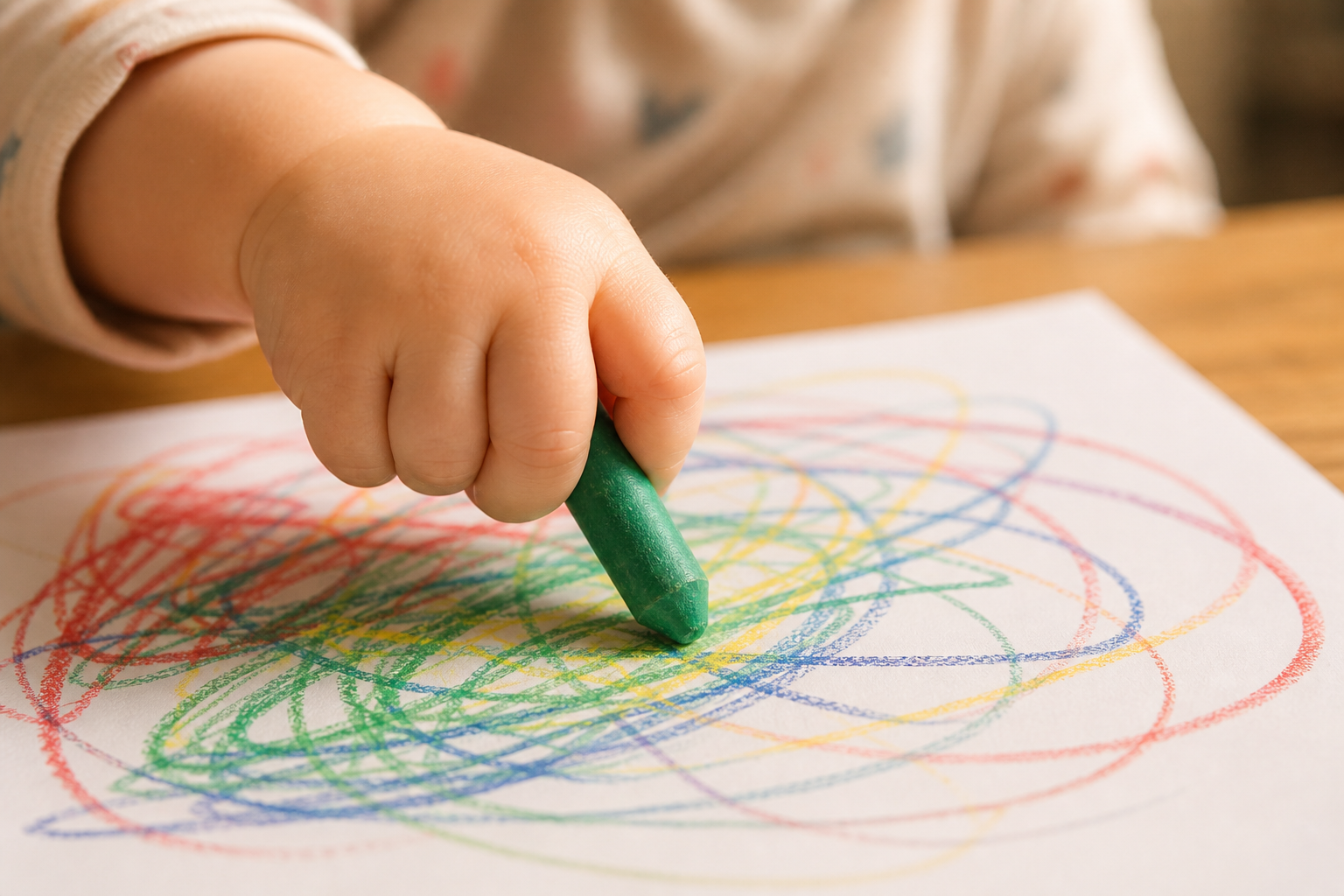
Watch the grip first. A young toddler holds a crayon in a closed fist and moves from the shoulder and elbow, not the fingers. The marks come from swinging the whole arm: big arcs, back and forth, around and around. Over the next couple of years that control travels down the arm, from shoulder to elbow to wrist to fingers, which is why finer movements show up later rather than sooner. Occupational therapists describe coloring developing along exactly this sequence, from fisted whole-arm strokes toward finer finger control (The OT Toolbox).
That is also why coloring earns its reputation as early hand training. The same grip-and-press work that fills a page is quietly building the strength and coordination a child will later use for buttons, zippers, and a pencil. We go deeper on that in how coloring builds focus and fine motor skills, but the short version is simple: at this age, the motion is the whole point and the picture is a side effect.
What to expect from two to four
Toddlers change quickly, so it helps to know roughly where your child is rather than measuring them against a finished drawing. Treat this as a rough map, not a schedule. Children reach each point on their own clock.
| Around this age | What the grip looks like | What ends up on the page | A page that fits |
|---|---|---|---|
| Two | Whole fist, whole arm, paper often needs holding down | Big looping scribbles, dots, lines that run off the edge | One huge shape, thick outline, almost empty |
| Three | Fingers start to join in, marks grow a little more deliberate | Circles, back-and-forth fill, more color in roughly the right area | A few large, simple shapes with clear space between them |
| Four | A steadier finger-and-thumb grip begins to emerge | Aiming for shapes, sometimes staying near a line on purpose | A bigger picture, a handful of distinct areas, still forgiving |
Why staying in the lines is the wrong goal right now
Coloring neatly inside an outline is a real skill, but it is a later one. It leans on a steady grip, good control of small movements, and the patience to slow down, and most children do not have all three until somewhere around four or five (Scholastic). Asking a two year old to stay in the lines is a little like asking someone to write in cursive before they can hold the pen.
So when the whole page vanishes under one color, treat it as a win, not a miss. The child practiced the grip, covered a space, and stayed with the task. That is the developmental work. The lines can wait for the year the hand is ready for them.
How to set it up without pressure
A few small choices keep coloring relaxed and let the practice happen on its own.
- 1Pick almost-empty pages. One big, friendly shape with a thick outline gives a toddler room to move and nothing to fail at.
- 2Use chunky crayons. Fat crayons and short, stubby ones suit a fist and a developing grip far better than thin ones, and they survive a heavy hand.
- 3Tape the paper down. A young toddler often cannot hold the paper and color at the same time, so do that part for them.
- 4Color next to them, not over them. Work on your own page nearby. Skip the corrections and the color-names quiz, and let them watch how you do it.
- 5Keep it short. Two or three minutes of real attention is plenty at this age. Stop while it is still fun.


Coloring fun for kids — anywhere.
Free for iOS & Android. No ads, no sign-up, offline-ready.


Coloring fun for kids — anywhere.
Free coloring app for kids. iOS and Android, phones and tablets. No ads, no sign-up, even offline.
When to relax, and when to mention it
Almost everything that looks like a problem at this age is not one. Scribbling instead of drawing, using a single color again and again, losing interest after a minute, refusing a coloring book entirely on a given day: all of that sits comfortably inside normal. Both interest in making marks and the pace at which a grip matures vary a great deal from one child to the next.
It is worth a casual mention at a routine checkup if, by around age three to four, a child shows no interest at all in holding a crayon or making marks, or if their grip and hand use seem to be sliding backward rather than slowly moving forward. A pediatrician looks at the whole picture, including how a child uses their hands for everyday things like feeding and stacking, not coloring on its own. Bringing it up early is simply information, not alarm.
Easy first pages to try
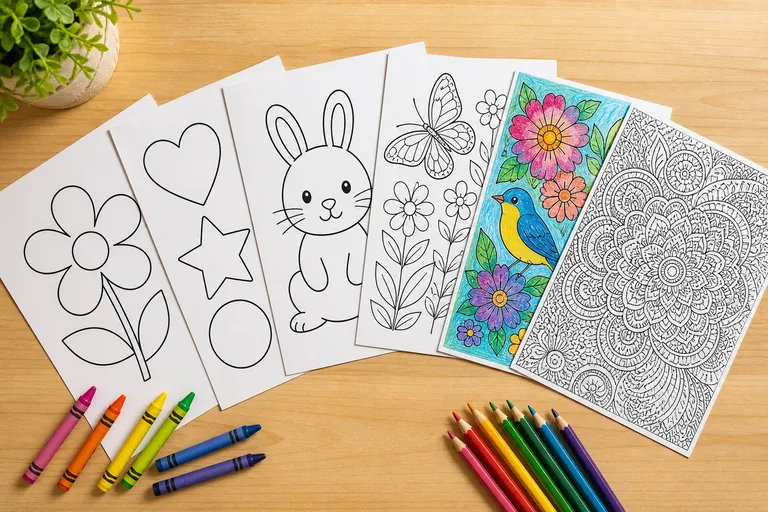
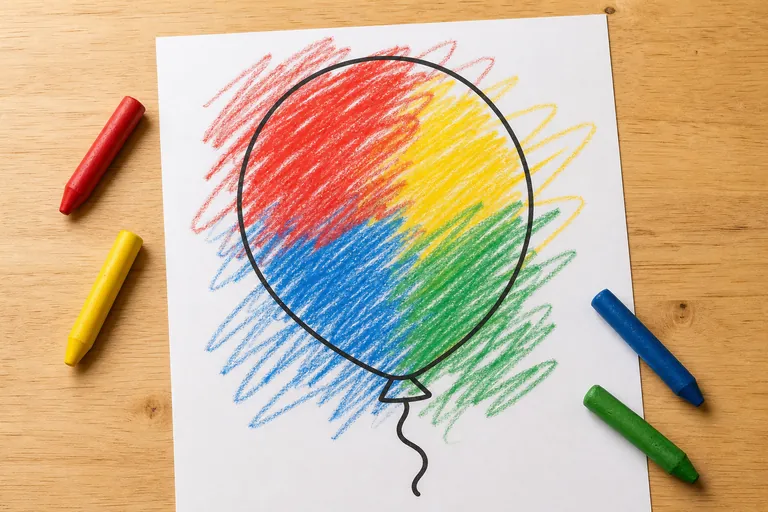
The best starting point is a page with one big shape and a lot of open space, the kind a toddler can fill in a single happy sweep. Soft, simple subjects work well, like big, simple cloud pages or a single round balloon, flower, or heart. When your child is ready for a little more, step up to slightly busier scenes one shape at a time.
Once you have found the stage your child is in, the coloring-by-age guide shows what comes next, all the way up to the tween years.
What else could you color?
Pick a prompt or type your own — opens in a new tab.