Hour three of the drive. The tablet died. The snack bag is empty. The four-year-old has discovered that she can kick the back of your seat at exactly the rhythm of a metronome.
This is when a folder of coloring pages saves the trip. Not a phone. Paper, crayons, and something that looks like a road sign or a campervan or a friendly cartoon car.
What makes a coloring page right for the backseat
Two things separate a great car coloring page from one that ends up crumpled under the seat. First, it has to grab attention in the first five seconds. A kid scanning the page should see a recognizable subject and want to start coloring immediately. Second, the lines have to be forgiving. A bouncy car ride is not the place for tiny details that require a steady hand. The mess factor is a separate issue: markers in a car are a decision you make once and never make again.
Coloring works in the car partly because it gives kids something to focus on that isn't their own boredom. Why Coloring Reduces Stress (And How to Start in Minutes) If you're curious about why that works neurologically, the short version is that the brain likes a small, achievable task to settle a restless body.
Our recommendations
For toddlers (2 to 4)
Big shapes. Single subjects, nothing on the page that doesn't matter. A toddler coloring in the car isn't going to fill in fine details. They're going to scribble all over a smiling car for ninety seconds, declare it done, and ask for another one.
Stack three or four of these in the seatback pocket. They'll go through them fast and that's the point. The cute cartoon vehicles from the collection below get a kid started without prompting because the smiling face is a clear invitation.
For 5 to 7 year olds
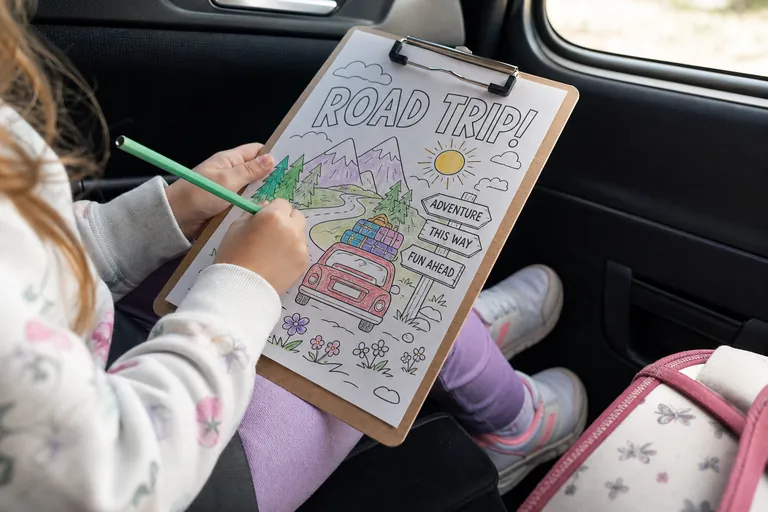
This is the age where coloring becomes a real activity, not a hand-warmup. A 5-year-old can stay in the lines (mostly) and will sit with a page for fifteen or twenty minutes. The right page for this age has a clear central subject with light context around it. A campervan parked by a lake. A picnic basket on a checkered blanket. A road sign pointing to the beach.
A useful tip: pages with a small detail to find work great here. Hide a bird in the trees, a frog in the picnic basket. Suddenly it's a coloring page and a seek-and-find.
For 8 to 12 year olds
Older kids want detail. The four-year-old's smiling car will get rolled into a paper ball before you leave the driveway. What works at this age: scenes with a lot going on. A busy highway with cars and trucks and motorcycles. A campground with tents and gear. A coastal road winding past cliffs and a lighthouse.
These pages take an hour or more if a kid is into them. Which is great when you're three hours from a rest stop.
For the 30-minute drive vs the 8-hour haul
Short trip: one or two pages, one box of crayons, done. A toddler might color one big subject for the whole drive and that's success.
Long trip: rotate themes. Start with the easy ones, move to medium, save the most detailed for hour four when the meltdown risk is highest. A coloring page that takes 45 minutes is a coloring page that bought you 45 minutes of quiet.
A useful rule we've landed on: bring twice what you think you need. Pages are light. The cost of running out is a meltdown. The cost of bringing too many is a slightly fuller folder.
Common mistakes parents make
Bringing markers in the car. They will end up on the upholstery. Always. Even the washable ones leave ghost stains. Crayons or colored pencils. That's it.
Giving one giant book instead of separate sheets. A book is heavy, awkward to hold in a car seat, and a kid who wants to redo a page can't. Loose sheets in a folder beat a book every time. 25+ Cloud Coloring Pages for Calm, Daydreamy Afternoons with Kids The same idea applies to calm-down coloring at home, but the constraint is even tighter in a moving car.
Picking pages that are too detailed for the kid. A 4-year-old handed a detailed campground scene will color one tent brown and announce they're done. A 9-year-old handed a smiling cartoon car will roll their eyes and ask for the phone. Match the page to the kid, not the other way around.
Not having a hard surface. A clipboard or a hardcover book under the page is the difference between coloring and frustration. We keep one clipboard per kid in the car at all times. Star Coloring Pages: 25+ Magical Printables Kids Will Love Quiet, focused activities like coloring work for the same reason calm-themed pages work at bedtime. Both rely on a flat surface and steady focus.
Forgetting to praise the half-finished page. A kid colors for ten minutes, then loses interest. Don't say "you didn't finish." Say "I love how you did the wheels." The point isn't a museum-ready coloring page. The point is fifteen minutes of not asking are we there yet.
The full collection
FAQ
How many coloring pages should I bring on a road trip?
Plan for one to two pages per hour of driving, per kid. A toddler will burn through five short pages in an hour. An 8-year-old might spend an hour on one detailed scene. Bring more than you think. Pages weigh almost nothing and the cost of running out is high. Twelve pages for a four-hour drive is a comfortable cushion, not overkill.
Are crayons or colored pencils better for the car?
Colored pencils win for older kids and longer drives. They don't melt in a hot car and they don't break as easily on bumpy roads. Crayons work for toddlers because they're chunky and forgiving. Skip markers no matter what age. Twistable colored pencils are a sweet spot. No sharpener needed, no broken tips.
What's the best way to organize coloring supplies in the car?
A pencil case clipped to the seatback pocket and a folder of loose pages on a small clipboard. The clipboard gives kids a hard surface, which matters more than parents realize. Avoid loose crayons rolling around. They end up in the cupholders or under the front seat where you'll find them in October.
How do I keep a kid interested in a coloring page longer?
Two tricks work consistently. First, ask questions about what they're coloring. "Where is that campervan going? Who's driving?" A story turns coloring into a longer activity. Second, save the most engaging pages for the hardest hour of the drive, usually around the three-hour mark when patience runs thin.
My kid hates coloring in the car. What now?
Some kids genuinely can't focus on detailed work in a moving vehicle. For them, swap coloring for stickers, sticker scenes, or maze and dot-to-dot pages. Same paper-based principle, less precision needed. Or use coloring as a rest-stop activity rather than an in-car one. Twenty minutes of coloring at a picnic table beats forty minutes of trying to color while motion sick.
Can my toddler use coloring pages without getting bored?
For a 2 to 3 year old, ninety seconds per page is normal. Stack ten simple pages and let them rip through. The goal isn't a finished coloring page. It's the act of marking the paper. How Coloring Pages Build Focus, Fine Motor Skills, and Steady Little Hands Even those quick scribbles are building grip strength and pre-writing skills. A "finished" toddler coloring page is one with marks on it. Lower the bar and the activity lasts longer.
The road trip coloring kit isn't complicated. Twelve pages, a clipboard each, colored pencils, and a folder to keep it all together. Pack it once at the start of summer and toss it in the car for every drive after. By August, the kids will know which pages are theirs and which belong to their sibling, and you'll have something to hand them when the snacks run out four hours in.