A four-year-old crouches over a moth on the patio. She names it "Glittery." She wants to draw it. You don't have a drawing of a moth, and any photo you find on your phone is the wrong shape for what she's holding in her head. This is the gap a good bug coloring page closes, and it's the gap most parents don't realize exists until a kid is already excited about a beetle.
Summer is when bug interest peaks. Kids find them, give them names, and invent whole stories around them. The problem is that searching for "bug coloring pages" pulls up a wall of generic line art, half of it cartoonish, half of it eerily anatomical. Choosing well matters more than most parents think. The right page extends a kid's curiosity into something that lasts longer than the bug did. The wrong one gets one perfunctory minute of attention and goes in the recycling.
This guide is sorted by what kids actually want to color, not by Latin classification.
What makes a bug coloring page actually work for kids
Three things separate a page a kid will sit with from one they'll abandon in thirty seconds.
The first is recognizability. Kids want the bug on the page to look like the one they saw on the porch. Overly stylized line art (smiling caterpillars wearing top hats) loses kids who came in with a real-world curiosity. The second is appropriate complexity. A four-year-old cannot color a dragonfly with twelve wing panels. An eight-year-old will be bored by a single-shape ladybug. Match the page to the kid, not to your idea of "cute." The third is room to make choices. Bugs aren't one color. A real swallowtail caterpillar is striped in ways most kids have never seen. A page that invites a kid to make decisions ("what color do you think this one is?") does more for them than a page that's already implied an answer.
Coloring sessions like this do something else, quietly. Why Coloring Reduces Stress (And How to Start in Minutes) holds up here too: when a kid leans into a page that matches their real curiosity, the calming effect is observable. There's nothing mysterious about it. It's just attention going somewhere.
Our recommendations, sorted by what kids ask for
We organize bug pages four ways. Most kids will gravitate to one category and ignore the others. Some kids cycle through all four. The point is to know which kind of kid you have on a given afternoon.
Pollinators (the calm-down category)
Bees, butterflies, moths, hoverflies. These are the pages to put out when you want a kid to settle. The shapes are forgiving. The colors are pretty without being prescribed. Pollinator pages pair nicely with the slow-paced afternoon coloring we wrote about in 25+ Cloud Coloring Pages for Calm, Daydreamy Afternoons with Kids, because the visual rhythm is similar: soft, looping, no hard angles.
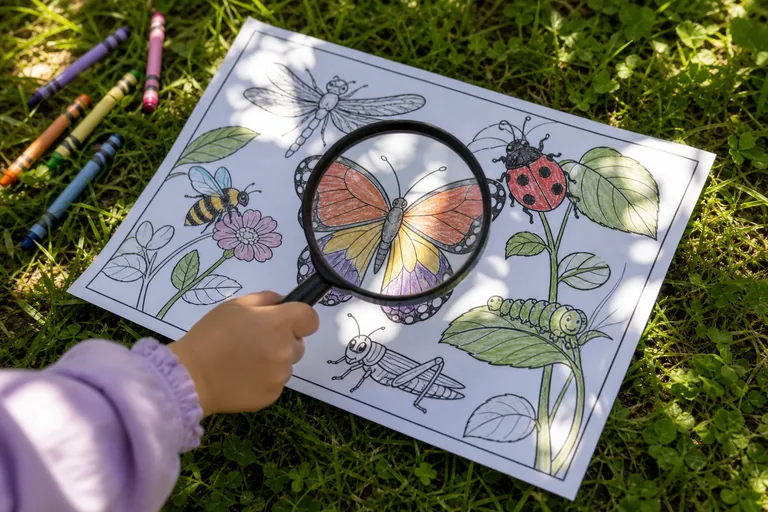
A bee page works for almost any age. Toddlers will color the body one block of yellow and stop, satisfied. Older kids will get into the wings, the stripes, the flower it's hovering over. Butterflies are the highest-traffic page in this category; their symmetry tempts kids to match the two sides, which is its own quiet motor-skill workout.
The pretty crawlers (entry-level for cautious kids)
Ladybugs, dragonflies, mantises, fireflies. Kids who say they "don't like bugs" almost always like these. They're bug-shaped, but they read as friendly. A ladybug page is the safest icebreaker we know of for a kid who's never voluntarily colored an insect.
Dragonflies pull older kids in. The wing pattern alone gives a seven-year-old twenty minutes of careful work. Fireflies are the surprise win at bedtime, especially in the week after a kid has seen them flickering in the backyard for the first time. The page becomes a memory.
Creepy crawlies (the pull-them-in category)
Spiders (yes, technically arachnids), beetles, ants, centipedes. These are the pages that get a reluctant kid to engage. Something counter-intuitive happens here: kids who refuse pretty bug pages will lean into the spider page because it has a small edge of risk and a small edge of pride. They feel brave for coloring it.
Beetles deserve their own moment. A stag beetle outline is one of the most rewarding bug pages a child between six and ten can color. The jaw shapes invite weird color choices. Most kids will not pick brown. They will pick green, purple, electric blue. Let them.
The surprising favorites
Snails (not insects, we know, kids don't care), worms, pill bugs, caterpillars. These pages are usually skipped by adults and grabbed by kids the second they're put out. A caterpillar with thirty segments is a coloring page that turns into a small project, especially if you suggest making each segment a different color.
Pill bugs are our quiet recommendation. They're shaped like little tanks, kids find them under every rock, and the page rewards a slow, patient hand. Some kids will color the same pill bug three times trying to get the segments right. That is a good afternoon.
Common mistakes parents make
Here is where we get opinionated. Many of the bug coloring pages floating around online are bad for kids, and parents pick them because the thumbnails look cute. Cute thumbnails do not equal good pages.
Skip the cartoon-eyed bugs. A bee with eyelashes and a wave teaches a kid that bees are characters. It does not extend their actual curiosity about the bee on the lavender. If you want a kid to develop a real interest, give them a page that looks like the bug.
Skip pages that are too small. Tiny bug outlines on a printed page are a fine-motor disaster for kids under six. The crayon won't fit, the lines blur, the kid gives up. Look for pages with a generous central subject and white space around it, not a page jammed with twelve insects competing for attention.
Skip rainbow themes for pre-K. A "rainbow bug" page sounds joyful and prints horribly in practice. The four-year-old will color the whole thing brown and feel like they failed. Single-subject pages with clear shapes are better for that age every time.
Don't be afraid of the slightly scary ones. We get a fair number of parents asking whether spider coloring pages are appropriate. They almost always are. A spider page that is anatomically clear (eight legs, two body segments, a thoughtful eye arrangement) is one of the most engaging bug pages for kids in the five to nine range, especially the ones already a little obsessed with monsters. The page channels that interest somewhere productive.
If you are building a longer summer coloring routine, the principles we lay out in Earth Day Coloring Pages Kids Will Love This Spring for nature pages carry across to bugs almost exactly. Pair a bug page with a five-minute look at the actual creature outside when possible. The page becomes a record.
Putting them to work
A bug coloring page works hardest when it is tied to a real moment. The morning after a kid spots a butterfly in the garden, a butterfly page lands. After a backyard rock-flip turns up a beetle, that evening calls for a beetle page. On a rainy afternoon when pill bugs are out under the porch, a pill bug page is exactly right. The page is a way to keep a small experience alive.
Three quick ideas. Make a "bug field guide" binder where the kid colors a page for every insect they have personally spotted; by the end of August, most kids have ten to fifteen pages, and the binder becomes a small thing they are proud of. Use bug pages as a quiet activity at restaurants; tuck two or three into the diaper bag with a small pack of crayons. Use bug pages on rest days; a kid who has been overstimulated all morning will often choose a pollinator page over a screen if both are offered at the same time.
If your kid's interests roam from bugs to other small wildlife, the same principles in Under the Sea Coloring Pages: A Guide for Reef Fans, Whale Lovers, and Tide-Pool Detectives for sea creatures apply: match the page to what the kid is already curious about, not to what looks adorable on a thumbnail.
FAQ
Are spider coloring pages too scary for young kids?
Almost always no. Spider pages work especially well for kids in the five to nine range, including kids who say they "don't like spiders." The act of coloring shifts a slightly scary creature into a thing the kid is in charge of. A spider page is one of the best ways we know of to turn a low-grade bug fear into curiosity. If your kid is genuinely afraid, start with ladybugs or fireflies and work up.
What age is best for bug coloring pages?
Bug pages work from about three years old up through early elementary, with the sweet spot at four to seven. Toddlers do best with single-subject, large-shape bugs (think a big simple bee). Older elementary kids gravitate to detailed bugs like beetles and dragonflies with intricate wing patterns. Above nine or ten, kids usually move toward more illustrated or stylized art rather than line drawings.
Are bug coloring pages good for learning about insects?
Yes, and more than parents realize. Coloring a bug forces a kid to look at it carefully. They notice how many legs it has, where the wings attach, whether the antennae are long or short. That kind of slow observation is closer to real science than most "fun fact" learning. Pair the page with a brief look at the live insect when possible.
Why does my kid only want to color the same bug over and over?
Totally normal, especially between three and six. Kids work through one creature at a time, the way they work through one favorite book. Let them. Repetition is how kids consolidate interest. They will move to the next bug when they are done with the current one. Trying to push variety usually backfires.
What is the difference between bug, insect, and creepy-crawly coloring pages?
Mostly nothing. "Insect" is the technically correct term (six legs, three body parts), "bug" is the casual word kids use, and "creepy-crawly" is the playful label for anything small that moves, including spiders, centipedes, and snails. For coloring purposes, treat them as one big category sorted by what your kid responds to.
Can I use these pages at a summer birthday party or camp?
Yes, and they're underrated for both. Hand out a stack of bug pages plus a small box of crayons as a quiet-time station; kids settle into them faster than into a craft that needs instructions. They also work as a wind-down between high-energy games. Print extras, because at least three kids will want two pages instead of one.
A closing observation
Most parents don't think of bugs and quiet time as related. They are. A bug coloring page is the outside world rendered to fit on a kitchen table. Use it for what it actually is, which is a way to extend a kid's curiosity past the moment the actual bug crawled away. They'll color it slower than you expect, and they'll remember what they saw.